|
Sulzberger-Provided Advice on Giving Away a Trust Fund
November 24, 2019 at 10:47 pm
The New York Times Magazine "tip" column this week is headlined "How to Give Away Your Trust Fund."
"Don't ignore a feeling that you have more than you need," the column advises, describing a woman who "spent years feeling ashamed, when even her closest friends didn't know she had a trust fund."
It's something for a newspaper published by the sixth member of the Ochs-Sulzberger family to control the paper—a newspaper that itself is controlled by something called The 1997 Trust—to go around advising other families that, as the magazine article quotes someone saying, "we're all going to die from climate change anyway," so you might as well "redistribute" your money to "social-justice organizing led by people most impacted by oppression."
If the Ochs-Sulzberger family feels ashamed of its own trust, one wishes that it would work out the issues privately rather than inflicting them on newspaper readers. Otherwise they risk giving readers the impression that the family feels there's some kind of difference between themselves and the non-Sulzberger rich; trust funds are fine for descendants of Adolph Ochs, but everyone else ought to shut theirs down and give to money to social-justice organizing.
Though some might jest that, given the financial return on The 1997 Trust compared to other possible investments since it was created, and given at least some of the content of the Times, the Ochs-Sulzbergers may have been not quite as hypocritical on this front as it might seem.
The Times Versus the Book Industry
October 30, 2019 at 6:56 am
Under the headline "Tip of the Week," under the overall headline "Smarter Living" Monday's print New York Times carries an article claiming "Creating the right money habits is crucial to reaching a financial goal." The article, by Kristin Wong, says, "Let's say your goal is to stop spending money on restaurants, clothing, gadgets and books this year." It advises taking the goals one month at a time.
Does the Times really want to help readers stop spending money on books? Its pages are full of advertisements for books and reviews of them. Its reporters are often off on book leave writing them. It seems inconsistent. Think of all the books one could afford and all the time one might have to read them if one created "the right money habit" by stopping spending money on newspapers.
"White" Democrats
October 30, 2019 at 6:36 am
"The Democratic field has a top tier of four white candidates, three of them men," the New York Times reports on its front page today atop a long news article. The "four white candidates" the Times has in mind are Biden, Sanders, Warren, and Buttigieg.
Lower down in the article the Times acknowledges that "Ms. Warren, of course, would be barrier-breaking in her own right as the first woman to be president, as would Mr. Buttigieg, an openly gay man." But nowhere in the article is any acknowledgement of the Native American identity that Warren claims and claimed when she was applying for law professor jobs. It's hard to know what to make of the omission. Does the Times just think that the claim is so thoroughly bogus that it isn't worth mentioning, even in an aside? Does it think Native American women don't count as people of color? Does it have some percentage-of-ancestry threshold for a Native American to be described as such? Does it not want to reinforce the "Pocahantas" tweets of President Trump? The Times article would have been improved by the addition of an acknowledgment of this history.
The Times Magically Makes Taxes Disappear
October 5, 2019 at 8:58 pm
The New York Times has a long article online and in print headlined "The Middle Class-Crunch: A Look at 4 Family Budgets."
There are "Lauren and Trevor Koch," whose "Monthly take-home pay" is $4,000, and whose monthly expenses, according to the Times, total $3,232 including:
Rent on a two-bedroom house, $600
Groceries and dining out, $800
Student loans, $550
Transportation, $484
Credit card debt, $340
Utilities, $212
T-Mobile cellphone service, $100
YMCA family membership, $63
Diapers, $60
Savings, $25
and there are "Mike and Lindsey Schluckebier," whose "Monthly take-home pay" is $8,500,
and whose expenses, according to the Times, total $7,047 a month, including:
Mortgage on a three-bedroom house, $2,060
Retirement savings, $1,000
Groceries and dining out, $700
Afterschool care, $360
Health insurance, $265
College savings, $200
Utilities, including internet, $178
One car, $125
"Discretionary," including vacations and kids activities, $2,000
Charitable donations, $400
Out of pocket health care, $125
Tello mobile phone service, $12
And two other families, too.
What do all these families have in common? By some miracle, none of them appear to pay any taxes. No property taxes. No sales or use taxes. No quarterly estimated income taxes. No cellphone taxes. No excise taxes. Or if they do pay taxes, the Times doesn't find them worth mentioning in an article that details just about every other cent that is paid. For an article that dwells on how middle class families feel stressed and pinched by rising costs, it's just strange to not consider the costs of taxes. Even the Times' decision to use "take home pay" rather than total income as the starting point for its budget decision is misleading, because it ignores the payroll and income taxes that are withheld from paychecks.
The article carries the bylines of two reporters and must have been touched or looked at by at least an editor or two before making its way into the paper. It says a lot about the ideological blinders operating at the Times that no one along the way in an article about middle class family financial stress even thought to mention or include taxes as a factor, or if they did think about it, they were overruled. Do the people who publish this stuff think readers don't look at cellphone bills, don't look at restaurant receipts, don't look at paystubs, don't pay property tax bills?
The other humorous—or sad, depending on how you look at it—thing about this detailed Times look at four middle class family budget is that the other expense not listed for any family is that of a newspaper subscription. And who can blame the families? Why would they pay money for news that comes with such a blatant ideological tilt? Maybe some people would pay to indulge in a fantasy of a zero-tax existence, but the Times is marketing itself not as some kind of escapist fiction but as "truth."
New York Times Editorial Takes on Legacy College Admissions
September 8, 2019 at 10:57 am
The New York Times has a staff editorial calling on federal and state governments to push colleges to end preferential admissions treatment for children of alumni.
"Preferential treatment for legacy admissions is anti-meritocratic, inhibits social mobility and helps perpetuate a de facto class system. In short, it is an engine of inequity," the Times editorial says. "Continuing to give applicants an advantage simply because of where their parents went to school is, as one critic called it, 'a form of property transfer from one generation to another.'"
The humor here is in the Times denouncing, as obviously unfair, "property transfer from one generation to another." From the New York Times' own news article about the naming of A.G. Sulzberger as publisher: "A. G. Sulzberger will be the sixth member of the Ochs-Sulzberger family to serve as publisher since its patriarch, Adolph S. Ochs, purchased the paper in a bankruptcy sale in 1896."
So the Times wants to prevent colleges from allowing children whose parents were not lucky enough to inherit a newspaper from being advantaged instead by parental help in providing access to education? If the Times really wants to demonstrate its commitment to meritocracy, its opposition to the class system, and its opposition to "property transfer from one generation to another," A.G. Sulzberger can immediately resign as publisher, and he and his cousins, including the other cousins who work at the New York Times Co., can put the newspaper up for sale and give the proceeds away to the government or charitable non-profit news organizations with ironclad anti-nepotism policies. Unless and until that happens, the Times isn't a particularly credible messenger on this topic.
On the broader issue, why not allow the colleges and universities to make their own decisions on admissions policies and compete, free of government interference, on the basis of how whatever decisions they do make affects their reputations? If that approach is good enough for newspaper companies, why hold universities to a different standard?
NYT Nostalgic For East German Communism
September 4, 2019 at 10:03 pm
From a "Times Insider" account by Katrin Bennhold that appears in the Times under the clickbait headline "A Once-in-a Lifetime Reporting Dilemma: Should I Take My Clothes Off?":
Nudism, I discovered, was not just a quirky lifestyle choice. For many people from the former Communist East, it is among the cherished traditions that have faded somewhat since the Berlin Wall fell. Nudism had been a mini-rebellion against a Communist dictatorship, and it also represented the egalitarianism that now makes some Easterners nostalgic.
"There wasn't the social jealousy there is today, because no one was rich and nurses and engineers were paid the same," said Thomas Bandelow, a 40-year-old teacher swimming farther down the beach. "In an economy of scarcity, everyone is equal."
Nudity, too, is a leveler. And it, too, was changed by reunification.
In other words, everyone had to line up for the bananas when they were available in East Germany. But everyone could afford them.
I understand the distinction between the Times itself being nostalgic for East German Communism and the Times reporting on the apparent reality that some Germans are nostalgic for Communism. But given just how brutal and evil the East German regime was — for example, it shot people who tried to escape the "egalitarianism," and also tried to maintain control by an elaborate secret police system in which people spied on each other — there's nonetheless something downright cringe-worthy about this whole Times passage. In addition, it's inaccurate. East Germany wasn't really equal at all. The top people in the Communist party, elite athletes, and the secret police got better food and apartments, while people who ran afoul of them were sent to prisons where there were barely any bananas at all. Anyone with any experience in a Communist society knows this, so it's odd for the Times to promote the equality myth without a reality check.
Anti-Government
August 14, 2019 at 8:05 am
The front-page New York Times news article about protests in Hong Kong begins, "HONG KONG — Anti-government protesters clashed with Hong Kong riot police on Tuesday, crippling the airport for the second straight day and targeting a potent symbol of the city's position as a global center of commerce and finance that is essential to China."
Anti-government isn't the correct word here, unless the Times plans to start using it to describe, say, anti-Trump protests here in the U.S. The protesters aren't anarchists, at least so far as I can tell from other news coverage. They just oppose the policies that the Chinese Communist authorities are pursuing in Hong Kong, in violation of the liberty of the people who live there and in violation of the one country, two-systems agreement by which Great Britain turned authority in Hong Kong over to China. Instead of describing the protesters as "anti-government," why not describe them as "pro-freedom" or "pro-democracy" or "pro-rule-of-law."
By this definition, the Times is an anti-government newspaper, at least here in the U.S. Maybe the article was edited by a Brit who uses "government" the way American English uses "administration."
The Times, by the way, also hasn't so far weighed in with any staff editorials in full throated support of the most recent round of protests, though it did devote a single three-sentence paragraph to them in the midst of a long editorial denouncing President Trump's tariffs on China.
Bezos Versus Trump
July 19, 2019 at 7:32 am
The second paragraph of a news article on the front of the business section of today's New York Times reports, "Mr. Trump has long carried on a one-sided feud with Jeff Bezos, Amazon's founder, over some of the company's business activities and also over what the president refers to as 'The Amazon Washington Post,' though Mr. Bezos owns the newspaper personally, not as a corporate asset."
"One-sided"?
The Bezos-owned Post constantly depicts Trump in the most sensational terms as a threat to democratic norms, and Trump defends himself, and the Times sees it as a "one-sided" feud? Come on.
Earlier and additional coverage of the Trump-Bezos drama at our sister site FutureOfCapitalism.com is available here, here, here, and here.
An Anti-Semitic Cartoon
April 28, 2019 at 9:42 pm
An anti-Semitic cartoon published by the New York Times is the topic of a piece I wrote for the Algemeiner, and a second follow-up piece. I occasionally wonder if the time I spend criticizing that newspaper for its coverage of Israel and Jewish issues is worth it; these sorts of situations, in which even the vice president of the United States is marking the problem, the Times itself is apologizing, and a columnist of the Times is faulting his own newspaper for mainstreaming anti-Zionism, help to provide some validation on that front. At least I saw where this was headed, or what was involved.
Victory For Netanyahu Is Defeat For The New York Times
April 10, 2019 at 9:49 pm
One of the best things about the election results in Israel was the opportunity to write this column for the Algemeiner.
Little Known Malpass
March 15, 2019 at 5:36 am
A news article on the front of the Times business section about President Trump's choice to head the World Bank, David Malpass, reports, "Big questions remain about how Mr. Malpass, a little-known Treasury Department official who has previously criticized multilateral institutions for overstepping their authority, will run the 75-year-old institution."
It seems strange, or at least inaccurate, to describe Mr. Malpass as "little-known." The Times itself has been quoting him as an authority for decades, describing him not as "little-known," but rather, as an "expert." Here's a 2001 Times article in which Malpass, identified as "chief international economist at Bear, Stearns," is quoted alongside Robert Hormats, Robert Rubin, and Paul Volcker. An article that ran in 2007 on the front of the Times business section reported, "Those in the background giving advice to one or more of the Republican candidates include N. Gregory Mankiw at Harvard, who is aligned mainly with Mr. Romney; Richard Clarida at Columbia; James L. Sweeney and John F. Cogan at Stanford; David Malpass at Bear Stearns; and Kevin A. Hassett at the American Enterprise Institute, working principally with Senator McCain." Readers of the Wall Street Journal know Malpass as a frequent contributor to its op-ed page, and readers of Forbes know him as a columnist. He's even written for the op-ed page of the Times itself. And he ran for U.S. Senate in New York, albeit without a victory.
I guess how known or unknown Malpass is depends on your comparison point. He's less known than many pop culture celebrities. But in the world of Republican international economists, he's not exactly an unknown quantity, at least to anyone who has been paying any attention.
Trump and the Environment
December 27, 2018 at 8:07 am
Today's print New York Times carries a special section about how President Trump is wrecking the environment. I stopped reading at this sentence: "Mr. Trump's regulatory ambitions extend beyond Republican distaste for what they considered unilateral overreach by his Democratic predecessor; pursuing them in full force, Mr. Trump would shift the debate about the environment sharply in the direction of industry interests, further unraveling what had been, before the Obama administration, a loose bipartisan consensus dating in part to the Nixon administration."
My life is too short to go rummaging through the Times archives for coverage of the environmental policies of the Reagan and George W. Bush administrations, but my memory is too long to forget that coverage. Oh, okay, I'll rummage a little bit. Here is a 2003 Times editorial about Gale Norton, who was interior secretary in the George W. Bush administration: "Congressional Democrats and some moderate Republicans are only now realizing that what Ms. Norton is trying to engineer is not just a rebalancing of the scales but a revolution in public policy deeply at odds with a long bipartisan tradition of environmental stewardship and more threatening than anything attempted by James Watt, Ronald Reagan's reactionary interior secretary and Ms. Norton's onetime mentor."
Here is a 1983 Times news article about President Reagan's interior secretary, James Watt:
There also was little doubt that he was carrying out the President's agenda, not just his own, at the Interior Department.
Mr. Watt came to the department with a radical agenda for change - radical in the sense that it marked a sharp departure from Federal land and resource policies of the recent past. Declaring that the pendulum had swung too far toward conservation and away from the development of public resources needed for economic growth and national security, he moved swiftly to transfer some of those public resources to private industry.
In a bold stroke, he proceeded to open virtually the entire Outer Continental Shelf to bidding by oil companies. He offered record tonnages of coal in leasing public lands. He moved, unsuccessfully, to process pending applications for oil and gas drilling in Federal wilderness areas, and also pursued additional economic activity in National Wildlife Refuges. He sought to suspend additional spending for the acquisition of National Park lands, saying that available funds should be used to rehabilitate existing parks.
Mr. Watt did not seek to build a consensus for his far-reaching policies, but instead plunged ahead without apparent concern for the views of environmental groups, some members of Congress, and others who might object. He acted as though he were on a religious crusade to save the nation...
Pretty much in every instance — Reagan, George W. Bush, Trump — the Times has sought to portray the Republican administration as "radical," "a sharp departure," "deeply at odds with a long bipartisan tradition," or, in the words of today's piece, "unraveling...a loose bipartisan consensus." It raises questions about the credibility of the Times criticism.
There's a tension in modern journalism between accuracy and getting readers to click, share, read. The click-share-read impulse depends on outrage. The accurate thing would be to write that Trump, like previous recent Republican presidents, is adjusting the balance back away from regulation. But the "getting readers to click" thing to do would be to write that Trump, in a radical departure from bipartisan precedent, is unleashing a never-before-seen assault on the environment. This doesn't just serve the commercial interest of the publisher, it also serves the career interest of the journalist, because "unprecedented" gets the story onto the front page and into the Pulitzer entry pile, while "like previous Republican presidents" gets a shrug, at best.
Smartertimes itself can understand these temptations: we have the choice to frame this one as "the New York Times is departing from its usual standards and treating Trump worse than it has treated any previous president," or "the New York Times is portraying President Trump as a polluter of the planet, just as it has with other previous recent Republican presidents." Which one would you click on and share?
There's also a problem of the fact that the Times has bought out or laid off or written obituaries for most of the reporters and editors who were around at the paper in 1983 and 2003. Some of the newspaper's readers are even too young to remember the earlier coverage. So when some Times reporter turns in a story claiming that the Trump assault on the environment is somehow new and different and unprecedented, the readers and editors may be naive or uninformed enough to believe it. At the very least, if the Times wants to convince readers that this is actually true, it might want to own up to the fact that it made essentially the same claims, using similar language, in previous Republican administrations.
Springsteen Debut
December 16, 2018 at 10:04 am
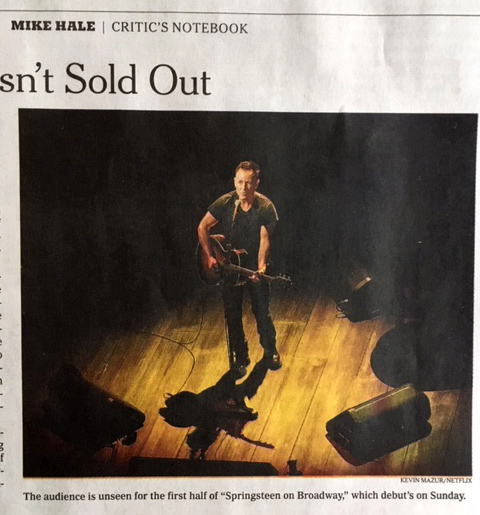
A photo cutline on the front page of the arts section of Saturday's Times, at least in my home-delivered print New England edition, reads, "The audience is unseen for the first half of 'Springsteen on Broadway,' which debut's on Sunday."
My hardcover Times Manual of Style and Usage insists, "debut. Use it as a noun (made a debut) or a modifier (debut recital), never as a verb (debuted)."
Even if one were to use it as a verb, doing so by adding an apostrophe "s" seems like a particularly egregious way of going about it.
It's one thing to see that sort of formulation in a high-school newspaper or in some free-on-the Internet publication. Or even on an inside page, or on a night when there's late-breaking news. But if the Times is going to try to position itself as a "premium product, premium price" and ask readers to pay $1,000 a year, the least it can do to hold up its end of the bargain is to try to get this stuff correct on an arts-section front. Or maybe it's old-fashioned or hopelessly naive of me to expect that the Times exercise some care about the proper use of the English language, and most of the other paying customers are just there to join in the wokeness? Anyway, it's hard to imagine seeing that sort of thing back in Allan Siegal's day. Perhaps it was caught and fixed for later New York editions.
Elizabeth Warren's DNA
December 7, 2018 at 8:03 am
A front-page New York Times news article reports about the backfiring of Senator Elizabeth Warren's decision to take a DNA test and disclose the results in connection with her claims of Native American ancestry: "Allies in Boston pointed out that, in Ms. Warren's recent re-election effort in Massachusetts, there was no evidence that the DNA announcement hurt her standing among voters."
These "allies" may have pointed that out, but it's the job of the Times to apply some skepticism and fact-checking before passing those claims along to Times readers. Here is a November 28, 2018, press release from UMass Amherst about the results of its most recent poll:
When asked who they would support today in the 2020 Democratic presidential primary among nine possible candidates, 19 percent of respondents indicated Biden, with 14 percent supporting Sanders and 11 percent supporting Warren...."While Senator Warren has emerged as a front runner for the Democratic nomination, she trails both Senator Sanders and former Vice President Biden in her own state. If she wants to win the White House she will have to tend to her own backyard," says Tatishe Nteta, associate professor of political science and director of the UMass Poll...Questions asked in the poll regarding current Massachusetts lawmakers' job approval sheds light on why Warren may have trouble in 2020. While her job approval among female voters was 62 percent, the poll found only 49 percent for male voters approve of her performance. The poll found that men were half as likely as women to support Warren in the 2020 presidential primary. And while 74 percent of young voters (age 18-29) approve of her performance in the Senate, only 48 percent of voters 55 or older approve. She holds the support of 6 percent of these older voters for a potential 2020 run for the White House.
Additionally, in the midterm election, Warren won re-election with 60.4% of the vote, while the state's Republican governor, Charlie Baker, won re-election with 66.8% of the vote. In other words, Warren ran 7 percentage points behind a Republican governor in the same election, in a Democratic state where President Trump isn't particularly popular. By contrast, Senator Edward Kennedy was reelected with 72.6% of the vote in 2000 and with 69.3% of the vote in 2006. It's not clear how much of all this is because of the Native American situation and how much is because of other issues, but as Professor Nteta observed, Warren's not without challenges among voters in Massachusetts.
Maybe it's a bit much to expect the Times to point this out in the context of what is, after all, a pretty negative story about Warren in the first place. But it's the reality. And given that a lot of the Times political editing team has been and is people with Massachusetts experience such as Carolyn Ryan and Patrick Healy, maybe it's not too much to expect. In any event, it didn't happen this time.
Harold Levy
November 28, 2018 at 7:40 am
The New York Times obituary of Harold Levy, a chancellor of the New York City public schools, includes this passage:
Appointed on an interim basis by the Board of Education in January 2000, explicitly against the wishes of Mayor Rudolph W. Giuliani, Mr. Levy, a small, energetic man who arrived at his new office in a pinstriped suit carrying a pillow embroidered with "No Good Deed Goes Unpunished," faced daunting challenges directing the nation's largest public school system.
It was a behemoth with 1.1 million students, 84 percent of them from minority groups; 78,000 teachers whose contracts were expiring and whose ranks faced heavy retirement losses; an aging infrastructure of 1,145 schools, most of them overcrowded and decrepit, and a $13 billion budget that experts called inadequate.
I'm about the last person to go around with a microscope seeking race-related things to be offended by, but describing a school system with a large percentage of children "from minority groups" as being a "daunting challenge," akin to an "inadequate" budget or a "decrepit" infrastructure seems to me to be jarring, cringe-inducing. It's an example of what president George W. Bush called the soft bigotry of low expectations. At the very least, it runs counter the the more conventional liberal wisdom that diversity is a strength. Merely being from a "minority group" is not necessarily an indication that a student presents a challenge to a school system. Some minority groups, such as Jews or Chinese Americans, place a high cultural value on education and do well enough that they wind up over-represented, relative to their presence in the population, in places that select on the basis of academic performance.
If a Republican political candidate or judicial nominee said something like this, the Times would have a field day with it. Yet when it comes in the faux-authoritative — fauxthoritative? — voice of the news columns of the Times itself, Times editors and probably a lot of readers, too, just race along past the embedded assumptions.
<- Prev 15 items | Next 15 items ->
|
|



