|
Times Portrays Belarussian Escort as 'Publicity Seeker'
March 7, 2018 at 10:29 am
A New York Times dispatch from Bangkok reports on "A Belarusian escort with close ties to a powerful Russian oligarch" who "said from behind bars in Bangkok on Monday that she had more than 16 hours of audio recordings that could help shed light on Russian meddling in United States elections"
Lower down, the article says, "Ms. Vashukevich and Mr. Kirillov, who also goes by the name Alex Lesley, are prominent on social media and are considered by some to be publicity seekers."
This struck me as a bizarre formulation. "Are considered by some" is the passive voice that is usually a danger signal that the Times is trying to spin a story. The Times doesn't say who these "some" are.
What's more, lots and lots and lots of people quoted by the Times or written about by the Times are also "publicity seekers," and the Times rarely if ever goes out of its way to point out the fact. There's an old joke that the most dangerous spot in Washington is between Chuck Schumer and a television camera. Does the Times describe Mr. Schumer as a "publicity seeker" every time that it reports on one of Senator Schumer's Sunday press conferences?
It reminded me of the Fox Butterfield profile of Patricia Bowman. The Times ran a correction acknowledging that "many readers" "inferred" that the publication of the piece "suggested that the Times was challenging her account." Whether this Belarusian escort is or isn't credible is a fair question for the Times to ask internally and to try to help readers assess themselves with context and information. But the vague statement that she is "considered by some to be" a "publicity seeker" seems to this reader, at least, to be not particularly helpful. When President Trump talks like that — "many people are saying," "a lot of people are saying," "I'm hearing" — the Times makes fun of him.
An Anti-Nepotism Editorial
March 2, 2018 at 8:26 am
With just a brief nod to the irony-verging-on-comedy involved, the New York Times unleashes a rare "editorial series" on the supposed evils of what the Times calls "nepotism in the White House." Says the Times: "A legacy of family control has helped sustain many private companies, including The New York Times." Then it goes on about "the corrosive effect of such nepotism: Even an incompetent in-law can reject the directions of the most experienced staff members; access — the currency of government — is unchecked; dismissal is difficult no matter how deserved; and ethical standards are near-impossible to enforce."
My own view of it is that the Times isn't just hypocritical here, it's also just wrong; a president's relatives can be among his most valuable advisers, as I wrote in this column for the Las Vegas Review-Journal.
ABC Carpet
March 1, 2018 at 9:46 am
An article in the Thursday Style section reports:
In the 1990s, ABC Carpet on lower Broadway ushered in its own major rug trend, selling Orientals that had been dyed in bright colors like pink, blue, red or silver. Seemingly every well-off woman who instructed her hairdresser to give her the "Jennifer Aniston" had one.
But ubiquity has a way of creating openings for new things to come along. Or as Ryan Korban, the design guru to the fashion designers Alexander Wang and Joseph Altuzarra, put it: "ABC carpet hasn't changed substantially in 10 years. Tell me you don't agree with me. It's the same chairs and the same rugs as they had when I was in college. There's only so many times you can go to the same place and look at the same kind of stuff."
You might expect ABC Carpet to have gotten an opportunity to respond in the Times to this harsh criticism, but the article does not include a response or any indication that one was sought before publication. Maybe this is hypocritical of me because I'm not seeking the Times' response to this criticism before publication, but it seems like shabby treatment. What made me notice it particularly is that ABC Carpet used to be a major advertiser in the print New York Times. It's hard to imagine the store getting this sort of treatment from the Times back in that era when it was a major advertiser.
It's often argued that the shift to reader or subscriber revenue and away from advertising revenue is a healthy journalistic development for the Times because the newspaper's incentives are better aligned by being beholden to readers rather than to advertisers. Now the newspaper can write negative things about retailers without having to worry about losing advertising revenue, because there isn't revenue to lose. This example, though, may be an indicator that that view is too positive. Maybe the consequence is that the Times can now treat New York-based retailers just as poorly as it treats other people and companies that it writes about. It's not necessarily clear that that's a good development from the standpoint of journalistic quality.
Trump's 'War' on Law Enforcement
February 4, 2018 at 1:06 pm
A front-page New York Times "news analysis" article carries the online headline "Trump's Unparalleled War on a Pillar of Society: Law Enforcement." The promotional language for the story claims "President Trump has raised fears that he is tearing at the credibility of some of the most important institutions in American life to save himself."
This is precisely the sort of thing that erodes the Times' credibility. The Times article claims "The war between the president and the nation's law enforcement apparatus is unlike anything America has seen in modern times....the president has engaged in a scorched-earth assault on the pillars of the criminal justice system in a way that no other occupant of the White House has done."
The Times writes the whole long article with a mention of Nixon but with not any mention of the words "Obama" or "Black Lives Matter." Here for example is a statement from July 2016 from the National Association of Police Organizations:
We are currently in the midst of war on cops. This Administration helped foster the climate that made this war possible. The constant message that America's police need to be reformed, monitored, investigated, prosecuted without any distinction as to the merits and valor of the individual men and women who do this job is beyond tiresome, it is deadly....NAPO has been urging the President and Congress to restore local police officers' ability to have defensive gear such as helmets, shields and bullet resistant vehicles for over a year , but they have refused. In the Executive Order (Executive Order 13688) that prohibits our access to vital surplus military equipment, the Administration acknowledges that this gear fulfills legitimate police needs, and the lack of such gear "can have life-threatening consequences." However, the Administration, worried that some of these items "could significantly undermine community trust," concluded this concern outweighed the concern for police and public safety.
Also, elsewhere on the same Times front page is an article faulting the FBI for being slow to act against the doctor who was molesting Olympic gymnasts. By publishing that article, is the Times waging "war on a pillar of society" or "tearing at the credibility" of an "important institution"? Or is it merely accurately describing flawed behavior?
As I've written here before, one of the most crucial tasks of a news organization in the Trump era is explaining what's unusual and what's not unusual. At a certain point, when the Times keeps claiming things are "unparalleled" when in fact there are plenty of parallels, the newspaper starts to confirm Trump's description of it as inaccurate and biased against him.
Sunglasses
January 25, 2018 at 5:12 pm
The photo shows a partial page from the New York Times. 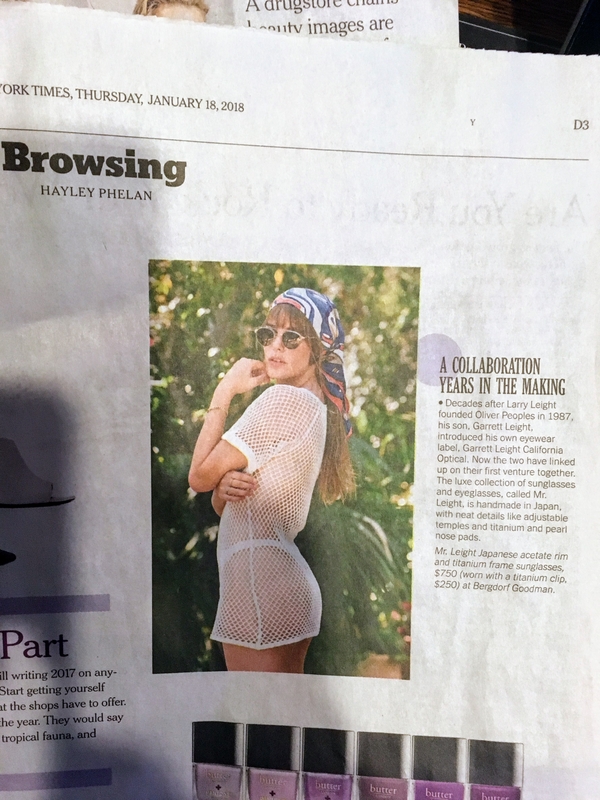
It's a shopping column about sunglasses for sale at Bergdorf Goodman. The Times illustrates the column with a photo showing not only the sunglasses but a woman in some kind of beach coverup that doesn't cover up that much. The Times doesn't say who took the photo — is it the work of the Times itself, or some sort of publicity handout? Either way, it seemed sort of odd, as if the Times somehow couldn't, or did not want to, find a way to write about the sunglasses without also publishing this picture.
Movie Piracy
January 25, 2018 at 9:40 am
A regular feature in the Times involves the newspaper interviewing its own employees about their use of technology. The latest installment, with the Times "Andes bureau chief," Nicholas Casey, includes this passage:
Beyond your job, what tech product are you currently obsessed with using in your daily life?
Netflix. There seem to be 10 times more offerings in Latin America than the United States, including many movies that are blocked back home and that I can only rent on iTunes. I would urge anyone who wants to spend days watching good films not available in America to set his or her VPN to Colombia and have a look.
The reason those movies aren't available in America is that Netflix and the owners of the intellectual property rights of the movies haven't reached an agreement to make them available. The Netflix terms and conditions state "You may view Netflix content through the Netflix service primarily within the country in which you have established your account and only in geographic locations where we offer our service and have licensed such Netflix content." If American users are viewing content in the way that the Times "urges," they'll be depriving actors, actresses, screenwriters, directors, and other creative types of compensation for their labor. It's not precisely shoplifting or theft, but it's skating on pretty thin ice in the direction of deception. If the Times journalist and editors can't understand this, imagine that the Times itself had different digital subscription prices for readers in the U.S. and in Colombia, with the U.S. price being higher and the Colombia price being lower. And then imagine that Smartertimes urged America-based readers to subscribe to the Times via a VPN set to Colombia.
If people are doing this sort of thing, it seems like maybe the sort of thing that Times technology reporters might want to report on by contacting the companies and interest groups who have stakes in the matter and then providing an evenhanded, impartial account of the issues involved, rather than by "urging" readers to circumvent the geography-based content controls that are in place to protect content that people worked hard to create.
Centrist Lee Zeldin
January 16, 2018 at 9:53 am
One of the funnier aspects of media bias is the way that publications adjust the labels that they hurl at politicians or academics depending on the publication's agenda at a given time.
An article in today's New York Times, for example, reports, "After the tax vote, House Speaker Paul D. Ryan canceled plans to raise money for a centrist New York Republican as punishment for opposition to the tax bill, a response that penalizes a member of the speaker's party just when help is most needed to win re-election."
A "centrist New York Republican"? Ever since George Pataki retired and Michael Bloomberg became an independent, "centrist" Republicans were the sort of thing that I thought the New York Times found only in the Massachusetts governor's office, if anywhere at all. But all of a sudden, the concept of a "centrist New York Republican" is useful to the Times because it can make Paul Ryan look extreme in comparison. So lo and behold, a previously fringe New York Republican is magically transformed for the purposes of this particular Times article into one who is "centrist."
Think I'm making this up? The Times doesn't name the Republican it is talking about, but a previous Times article, headlined "Paul Ryan Cancels Fund-Raiser for Lee Zeldin Over Tax Bill Vote," makes it pretty clear.
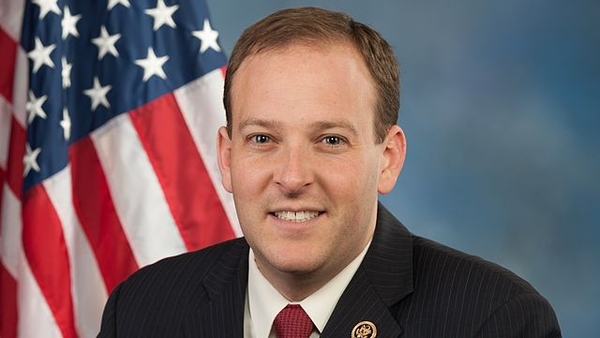 Congressman Lee Zeldin. (Image source: US Congress/Wikimedia Commons) |
Here's some previous Times coverage of Mr. Zeldin. A July 2015 Times news article describes him as a "firebrand," "caustic," a "Fox News staple," "ferocious," a "conservative" known for "strident hawkishness," "at the vanguard of conservative politics." The article reported that "Mr. Zeldin has taken votes that may prove challenging to defend in his moderate district, recently voting for a spending bill that cut spending for mass transit, and at one point opposing a measure to finance the Department of Homeland Security, because it did not block Mr. Obama's latest round of executive orders on illegal immigration." It quoted an opponent who accused Mr. Zeldin of "following the hard-right, Ted Cruz line."
A June 2016 Times news article reported:
On Long Island, Lee Zeldin, the Republican incumbent in the First District, has emerged as a strong supporter of Mr. Trump. He gained national attention recently when he defended the presidential hopeful's attack on a judge in a lawsuit involving Trump University; Mr. Trump had said the judge was biased because he was Mexican, even though he was born in the United States.
In defending Mr. Trump, Mr. Zeldin suggested that President Obama could be considered a racist because of some of his policies and statements.
Neither the 2015 nor the 2016 Times article described Mr. Zeldin as "centrist." But now that Speaker Ryan canceled a fundraiser for the guy, all of a sudden Mr. Zeldin's a centrist? The replacement speaker for Ryan at the event was Steve Bannon. It's not that Mr. Zeldin has suddenly become any more or less "caustic," conservative, or centrist. He's the same guy he's always been. What has changed is the usefulness to the Times in describing him in one way or another to attack whatever target the Times wants to attack.
Crime Is Falling, But Police Levels Remain Robust
January 8, 2018 at 9:09 am
A candidate for James Taranto's "Fox Butterfield" effect award is this New York Times news article, which appeared under the print headline, "Crime Is Falling, But Police Levels Remain Robust."
As the article itself concedes, "hardly anyone questions the size of police forces." Hardly anyone, that is, besides the New York Times.
The article is by Jose A. Del Real, whose LinkedIn bio describes him as a 2013 graduate of Harvard.
Newspapers exist in part to raise questions that "hardly anyone" is asking. But readers might be a bit less skeptical of the Times enthusiasm for shrinking the unionized government workforce if the enthusiasm extended beyond the police to other areas.
As for those who might contend that the size of police forces might have actually helped to reduce the crime rate, the Times dismisses that idea: "The relationship between the number of officers and lawful behavior is not clear-cut." The relationship between the number of reporters and editors in the Times newsroom and the amount of useful news they produce is not clear-cut, either.
A.G. Sulzberger Stumbles at the Start
January 1, 2018 at 7:03 pm
The newly installed publisher of the Times, A.G. Sulzberger, is out with "A Note From Our New Publisher" that suggests that maybe he might want to, you know, re-read the First Amendment before he spends much more time out in public on his new job. The "note" contains this doozy:
There was a reason freedom of speech and freedom of the press were placed first among our essential rights. Our founders understood that the free exchange of ideas and the ability to hold power to account were prerequisites for a successful democracy.
Uh, sorry to break it to you, Mr. Sulzberger, but there is no accurate count by which "freedom of speech and freedom of the press were placed first among our essential rights."
Not the Declaration of Independence, which said, "they are endowed by their Creator with certain unalienable Rights, that among these are Life, Liberty and the pursuit of Happiness." That one, in other words, put "life" on the list before liberty.
Not the Constitution itself, in whose original text the first right is that "The Privilege of the Writ of Habeas Corpus shall not be suspended, unless when in Cases of Rebellion or Invasion the public Safety may require it."
Not the Bill of Rights, whose First Amendment begins, "Congress shall make no law respecting an establishment of religion, or prohibiting the free exercise thereof," and caused religious liberty to be known as the First Freedom. Only after mentioning the religious freedoms does the First Amendment then go on to address the freedoms of speech, press, assembly, and petition.
Not the New York State Constitution, which places the right to vote, to trial by jury, to religious liberty, to habeas corpus, and to private property all ahead of the rights of speech or the press.
Not the Massachusetts Constitution crafted by John and Samuel Adams that was the model for the U.S. Constitution; it put property rights and religious freedom ahead of the press freedom.
Rights are rights, regardless of the order in which they are enumerated. But given that Mr. Sulzberger's note goes on to fret about "a dangerous confluence of forces," among them that "Misinformation is rising and trust in the media is declining" and "polarization is jeopardizing even the foundational assumption of common truths," you'd think the publisher would be more careful about himself contributing to the misinformation by claiming something that is just flat-out false.
One of the realities about the New York Times is that many of the people who work there are afraid of the members of the family that controls it. The best advice I can give A.G. Sulzberger as he takes over is, if he is going to be writing for the paper, to find someone smart to edit his copy who isn't afraid to tell him when he is wrong. Maybe it is another family member. Maybe it is a volunteer or consultant who isn't an employee of the family newspaper. The second-best advice would be to re-read the First Amendment.
Left-Wing News
December 27, 2017 at 8:36 am
Under the print headline "Labor Unions Gain Foothold At News Sites," my edition of the New York Times reported, "Members of the news staffs at Vice Media, ThinkProgress and HuffPost followed suit, organizing unions that their companies recognized and that subsequently ratified contracts."
I raised my eyebrows at the Times description of ThinkProgress as a "News Site" with a "news staff." Without appending a formal correction, the online version of the story carries a different headline: "Unions Are Gaining a Foothold at Digital Media Companies." And in the text of the article itself, the word "news" has been changed, so that the sentence that caused me to raise an eyebrow now reads: "Members of the editorial staffs at Vice Media, ThinkProgress and HuffPost followed suit, organizing unions that their companies recognized and that subsequently ratified contracts."
ThinkProgress' "about" page says "ThinkProgress is a news site dedicated to providing our readers with rigorous reporting and analysis from a progressive perspective. Founded in 2005, ThinkProgress is an editorially independent project of the Center for American Progress Action Fund."
Personally, I'm all for an extremely broad definition of the word "news" that includes content produced by 501(c) 4 advocacy groups such as the Center for American Progress Action Fund. At least ThinkProgress discloses its "progressive perspective" rather than pretending to be something it isn't, as the incoming publisher of the Times, A.G. Sulzberger, attempted in a recent interview with the editor of the New Yorker, David Remnick:
D.R.: For many in the general public, the New York Times is seen as a liberal newspaper. True or false?
A.G.S.: False. And I can send you all the hate mail that I've gotten from our aggressive coverage of the Clinton campaign.
D.R.: O.K., but do you really think that it's possible to argue that the New York Times, by and large, isn't both populated by people who are left of center, and that the tone of the newspaper isn't left of center?
Anyway, it's amusing to watch the editing changes disclosing some internal discussion or thought at the Times about precisely what meets the definition of "news." The writer whose byline is on the Times article, Matthew Sedacca, graduated from college in 2015 and from Columbia Journalism School in 2016, according to his online CV.
Family Business
December 25, 2017 at 6:29 pm
Is it just me, or is there a double standard in how the Times covers inherited wealth in its own family business versus how it covers it in other families — like, say the president's family real estate business?
Here is a Timothy Egan column dated December 15, from the Times op-ed page:
Do entitled rich kids who would otherwise be parking cars without Daddy's help — think Donald Trump Jr. and his brother Eric — deserve to inherit a vast estate without paying taxes on their unearned largess?
It's a rhetorical question, and you can probably guess Egan's answer from the way he phrased the question.
Here is a Jim Rutenberg column dated December 24, from the Times business section:
family-led newspapers placed their journalistic missions ahead of business imperatives. And they did so under intense governmental pressure, a reminder of the important role that principled family leadership plays in the news business.
That has particular resonance in The New York Times Building as Arthur Gregg Sulzberger prepares to take the publisher's reins from his father, Arthur Ochs Sulzberger Jr., on New Year's Day, extending the Ochs-Sulzberger family's stewardship of the paper to a fifth generation.
The idea of steadfast news leadership should matter beyond The Times's offices, given Mr. Trump's threats against the tax status of Amazon, the company founded by Jeff Bezos, who bought The Post in 2013, and his denigration of the financial performance of The Times, whose subscriptions and stock price experienced double-digit growth in 2017.
Both media properties have the protection of their owners — a family, in the case of The Times; and a billionaire, in the case of The Post — who are bulwarks against the blind market forces that would have them turn into clickbait-only versions of themselves.
There's plenty to quarrel with in the Rutenberg column. Regarding the Amazon tax issue, for example, The Times itself has acknowledged in its news columns that "because so many marketplace sellers do not collect sales tax, there is some legitimacy to the idea that Amazon is not doing everything it can to make sure the government gets its cut." The Rutenberg account studiously omits the role of the Times' own billionaire financial backer, Carlos Slim. As for "clickbait," both the Washington Post and the Times haven't entirely been immune to its temptations, while the "clickbait only" sites have themselves been battered by precisely the market forces that Rutenberg apparently disdains.
What made me chuckle, though was the disparity in the coverage of the younger Trumps — "entitled rich kids who would otherwise be parking cars" — and the younger Sulzberger — "principled family leadership...stewardship."
Trump and the Stock Market, Again
December 20, 2017 at 9:56 am
One of the most crucial tasks of a news organization in the Trump era is explaining what's unusual and what's not unusual. The New York Times has a major fail on that front in today's paper, with a news article by Michael Tackett. It begins:
WASHINGTON — President Trump has broken with many of the norms set by his predecessors, but in few ways has this been clearer than his cheerleading about the roaring stock market.
He is the unapologetic First Bull.
He has crowed about the stock market at least once a week for the past two months. In two Twitter messages early Tuesday morning, the president cited a 5,000-point rise in the Dow Jones industrial average this year, and then said the market had more room to roar once the impact of tax legislation he is expected to sign this week becomes law.
Other presidents have occasionally talked about market booms, but often avoided saying anything that could move markets, particularly on individual company stocks. More commonly, they have talked about unemployment numbers, housing starts and other indicators that are less sensitive to market forces.
Mr. Trump has ignored those conventions, with relish.
Even at a speech on national security on Monday, he took a detour to talk again about records being set in the markets. The market performance is now an almost standard part of any address he makes.
Got that? The Times accuses President Trump of having "broken" the "norms set by his predecessors," in a "clear" way, by ignoring the "conventions."
The problem is, Presidents Clinton and Obama also made stock market gains during their administrations "almost standard" parts of their addresses. You could look it up.
Here is Bill Clinton on March 9, 1993: "Our deficit reduction package—and Senator after Senator said today, you know, that this is the most credible budget I've seen in 15 or 17 or however many years—it is producing the desired results: low interest rates, stock market back up and doing well."
Here is Clinton again on March 11, 1993: "we are reaping the benefits of the clear and disciplined and determined effort that the congressional leadership has now agreed to make with me to bring the deficit down. We have interest rates at very, very low rates. We have the stock market back up."
Here is Clinton again on April 17, 1993: "Some profits of our corporations are up, stock market at record-high levels."
Here is Clinton again on April 24, 1993: "I know there's been some good news lately. After about 100 days as President we've begun to change the direction of America. Our economic program has been adopted in its broad outlines by Congress. That's brought an end to trickle-down economics. The stock market is at an all-time high, and interest rates are very, very low, mortgages at a 20-year low."
Here is Clinton again on April 27, 1993: "this town has finally gotten serious about cutting the deficit. That's one of the reasons we saw a big upturn in the stock market at the same time interest rates were hitting record lows. As you know better than anyone, these things can bring enormous long-term benefits to the economy."
Here is Clnton on June 2, 1993: "I'd just like to mention two things that I think support the economic position that I have taken and the work we're doing in the Senate. First of all, there were news stories today and yesterday pointing out that long-term interest rates are down again, the stock market is strong again in anticipation of the passage of a real deficit reduction package after the vote in the House. And that means we're taking the right course."
Here is Clinton on June 3, 1993: "In November, shortly after the election, our administration announced a serious attempt to reduce the deficit based on spending cuts, targeted revenue increases. Long-term interest rates started to drop. They've dropped almost one full point since the election. Last week, after the House of Representatives adopted the economic program, they dropped again, and the stock market went up again because people who control these decisions began to believe again that we could take control of our destiny and really move America forward."
Here is Clinton on July 30, 1993: "I think what you will see over the long run is a very strong stock market."
Here is Clinton on August 14, 1993: "With this economic plan in place, private analysts believe more than 8 million jobs will be created over the next 4 years. Already the plan has brought interest rates to historic lows and the stock market to historic highs."
Here is Clinton on April 4, 1994: "fundamentally it's a solid stock market and a very solid economy. And I think that's what should guide people in their long-term investment decisions."
Those are just a few examples from the Clinton era. I could provide literally dozens more. President Obama did the same thing.
Here is Obama on December 3, 2009: "We implemented plans to stabilize the financial system and revive lending to families and businesses. We passed the Recovery Act, which stopped our freefall and help spur the growth that we've seen. Today, our economy is growing again for the first time in a year and at the fastest pace that we've seen in 2 years, and productivity is surging. Companies are reporting profits. The stock market is up."
Here is Obama on December 14, 2009: "Today, due to the timely loans from the American people, our financial system has stabilized, the stock market has sprung back to life, our economy is growing, and our banks are once again recording profits."
Here is Obama on April 1, 2010: "the financial system has stabilized. I love, you know, in the midst of the crisis--you guys may remember last March, when the stock market was bottoming out—'This is Obama's stock market.' [Laughter] Wall Street Journal said that, 'Oh, look at his policies.' And I notice it's not my market anymore. [Laughter] I don't know what happened. You notice that? [Laughter]"
Here is Obama on November 2, 2015: "We were warned we couldn't reform Wall Street or create new protections for consumers or ask the wealthiest Americans to pay a little bit more without stifling the markets and crushing jobs. And we did it, and the stock market more than doubled, and we've seen the longest streak of job creation in American history."
Here is Obama on November 9, 2015: "We were told we couldn't put new rules on Wall Street or more protections for consumers or ask the wealthiest of Americans to pay their fair share of taxes without crushing job growth. But we did it. And the stock market doubled."
Here is Obama on July 23, 2016: "our economy is stronger today than it was before the crisis. Since we dug out from the worst of it, our businesses have added almost 15 million new jobs. Corporate profits are up, lending to businesses is up, and the stock market has hit an alltime high."
Here is Obama on November 23, 2016: "we have a lot to be thankful for this Thanksgiving: 6 straight years of job creation, the longest streak ever; low unemployment. Wages are rising again. Inequality is narrowing. The housing market is healing. The stock market has nearly tripled."
Even in his farewell address to the nation, on January 10, 2017, Obama sought to take credit for the stock market boom that accelerated in after Trump was elected: "the good news is that today the economy is growing again. Wages, incomes, home values, and retirement accounts are all rising again. Poverty is falling again. The wealthy are paying a fairer share of taxes even as the stock market shatters records."
As for the Times reference to "individual company stocks," President Obama endorsed companies including the Gap, Costco, and Aetna.
In announcing Mike Tackett's "new role" as "a national political correspondent," The New York Times said that his previous job had included "editing ...Linda Qiu's fact checks." Enough said.
Ten Ways The Times Jerusalem Editorial Got It Wrong
December 19, 2017 at 10:14 am
"Ten Ways The New York Times Jerusalem Editorial Got It Wrong" is the headline over my latest piece for the Algemeiner, which you can read here.
Uber's Lawyers
November 29, 2017 at 9:14 am
The lead business story in today's New York Times reports that Judge William Alsup of Federal District Court in San Francisco "accused Uber's lawyers of withholding evidence, forcing him to delay the trial":
"I can no longer trust the words of the lawyers for Uber in this case," Judge Alsup said. "If even half of what is in that letter is true, it would be an injustice for Waymo to go to trial."
Today's Times article does not specify what lawyer Judge Alsup was talking about. It doesn't name the lawyer or the law firm.
An August Times article did a better job:
"You misled the judge time and time again," Judge Alsup told Arturo González, Uber's outside counsel from the law firm Morrison & Foerster.
It would have been helpful for the Times to repeat this information for print readers or online readers who missed the August article or who don't recall it. It might also be helpful for the Times to give Mr. Gonzalez or his firm a chance to defend themselves. Often lawyers won't talk about a case publicly outside court while the case is underway, but even so, the criticism is so severe that the reader wonders if there's another side to it, or what, if anything, the lawyer has to say to explain himself. It'd also be useful for readers to understand how common this sort of finding by a judge is, and whether the lawyer risks facing any sanctions as a result. The Times seems to be covering the trial with technology and business reporters rather than legal or court reporters.
Liz Smith and Pat Buckley
November 16, 2017 at 10:47 am
A nasty piece in the Times by Jonah Engel Bromwich runs under the headline "Liz Smith's Complicated Relationship With the Closet." It posthumously faults a journalist for being what the Times deems to be insufficiently public about her sexual orientation. Mr. Bromwich writes:
At the height of her influence, in the 1980s and early '90s, Ms. Smith covered for still-closeted celebrities like Malcolm Forbes and promoted conservative socialites like Pat Buckley, whose husband, William F. Buckley Jr., the editor of National Review, had written that people with AIDS should be tattooed.
For those reasons, she came under fire by the columnist Michelangelo Signorile, who during the run of the magazine OutWeek named and shamed closeted gay celebrities whom he saw as hypocrites in the midst of a deadly pandemic.
The Times doesn't say so in the article (there is a hyperlink in the online version), but where did William F. Buckley Jr. make that tattoo suggestion? In a March 1986 op-ed in the Times itself.
It's a strange kind of sexism to suggest that a gossip columnist should have somehow punished or ostracized a woman as retribution for a piece of her husband's political writing. It's even stranger to suggest that the punishment should apply because of an article that was published in the Times itself. The tattoo proposal, which I am not endorsing here, appears to have been motivated not out of any sort of anti-gay animus but rather out of concern to stop the spread of the disease.
Mr. Bromwich graduated from college in 2011, according to his LinkedIn profile; William F. Buckley Jr. died in 2008.
<- Prev 15 items | Next 15 items ->
|



